
Tour of Duty: From Management Philosophy to Career Infrastructure
When Reid Hoffman, Ben Casnocha, and I published The Alliance in 2014, we had a specific problem we wanted to solve.
For too long, companies have demanded perpetual loyalty from employees without making any corresponding commitment to job security. It’s worse than a double standard — it’s a masquerade. Companies hire people knowing they’ll likely leave in a few years, yet expect those employees to profess a lifelong devotion that neither side actually believes in.
We proposed a different model: an alliance between employer and employee, structured as a series of tours of duty. A tour of duty is a defined period of employment with a specific mission — not an open-ended job, but a mutually agreed chapter with clear success criteria. Both sides understand what success looks like and what each gains from achieving it. When the mission nears completion, manager and employee work together to define the next tour — or acknowledge that the employee’s best opportunity lies elsewhere.
The book was a success. It hit the New York Times bestseller list. Over a decade later, I still meet leaders, managers, and employees who tell me the framework changed how they work.
But something has been missing.
The gap between philosophy and practice
We gave people a way to think about careers differently. We didn’t give them a system to act on it.
The Alliance included sample tour of duty documents, and we encouraged readers to create their own. But we couldn’t give them infrastructure — and we especially couldn’t give them a universal system that travels with them from company to company.
The framework lived in 1:1 meeting notes, performance review docs, and conversation memories that faded with every transition. Tour of Duty was a philosophy that depended entirely on exceptional managers remembering to practice it. When they moved on, the framework moved with them — out the door.
This is the fundamental problem with any management philosophy that lacks infrastructure: it works when someone champions it, and evaporates when they don’t.
From philosophy to product
Meanwhile, unbeknownst to us, Nagib Tharani was one of those devoted readers of The Alliance. He believed in the Tour of Duty framework and started applying it to his own career at companies like Clio and ServiceNow. It worked — his career accelerated. But like everyone else, he was struck by how manual the process was. There was no system of record. No structured way to document the competencies each tour developed. No portability when the tour ended.
He spent years working on this as a side project, and about a year ago began building in earnest with AI. The result is TailorCV — the first product I’ve seen that operationalizes the ideas of The Alliance.
This is rare for an author. You write a book hoping it changes how people think. You almost never get to see your ideas manifested in an actual product. I’m genuinely excited by what Nagib has built.
What the infrastructure looks like
When I say “infrastructure,” I mean something specific. Let me walk through what TailorCV actually does with the Tour of Duty framework.
Three tiers of tours
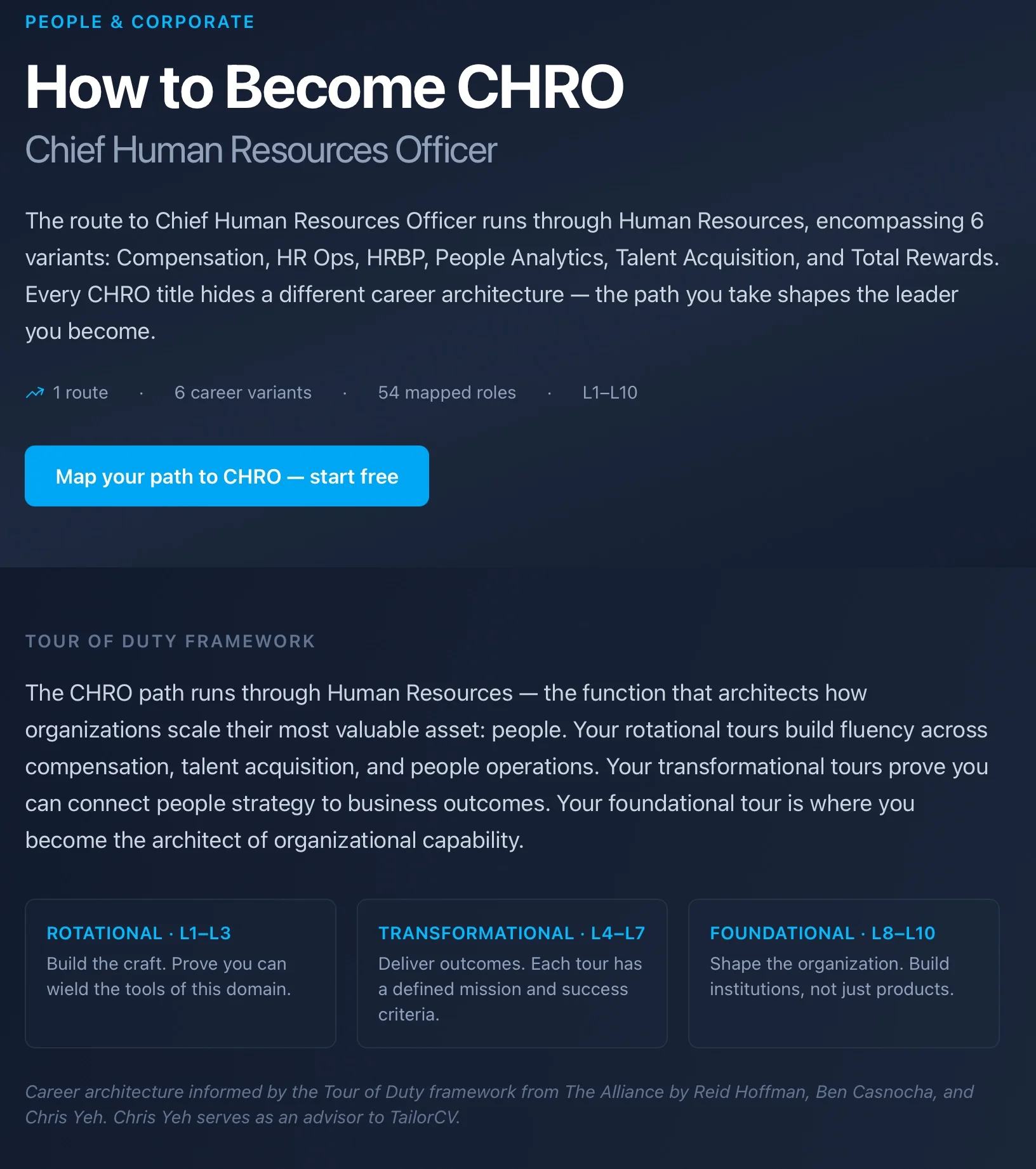
Every career path on TailorCV is structured around three tiers of tours — language that’s now live on every C-suite path page:
Rotational Tours (L1–L3): Build the craft. Prove you can wield the tools of this domain. These are early-career tours where the mission is learning. You’re building foundational competencies, not yet delivering strategic outcomes.
Transformational Tours (L4–L7): Deliver outcomes. Each tour has a defined mission and success criteria. Each level has a specific mission — not a job description, but a defined transformation. Success means the mission is complete and both sides are richer for it.
Foundational Tours (L8–L10): Shape the organization. Build institutions, not just products. Executive tours. You’re no longer building systems — you’re building the organization that builds systems.
This is the career arc mapped as a sequence of missions, not a promotion ladder.
Every role has a mission
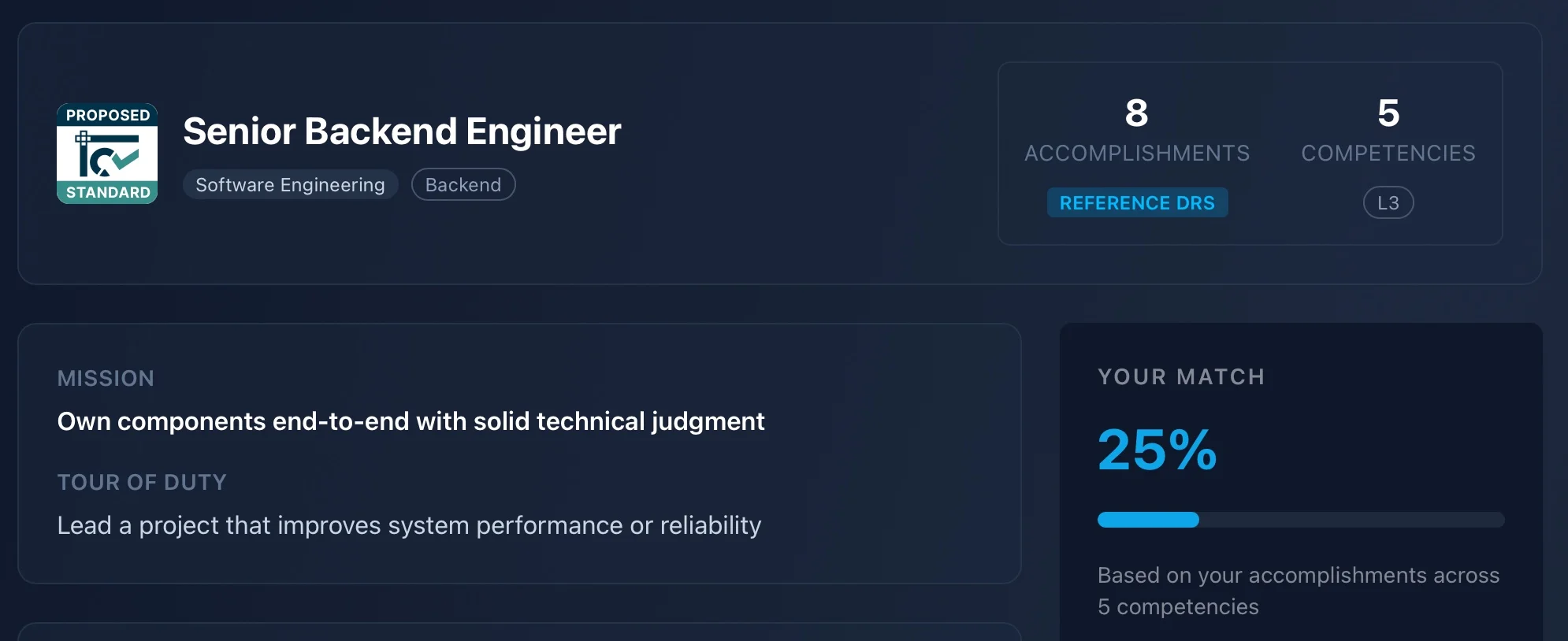
Open any of TailorCV’s 1,537 Digital Role Specifications and you’ll find a Tour of Duty field — one line that defines what success looks like at that level. For a Senior Backend Engineer, it reads: “Lead a project that improves system performance or reliability.”
That’s what was missing from our original framework. We told managers and employees to define missions together, but we didn’t show them what good missions look like at every level of a career. TailorCV does.
The bridge between tours
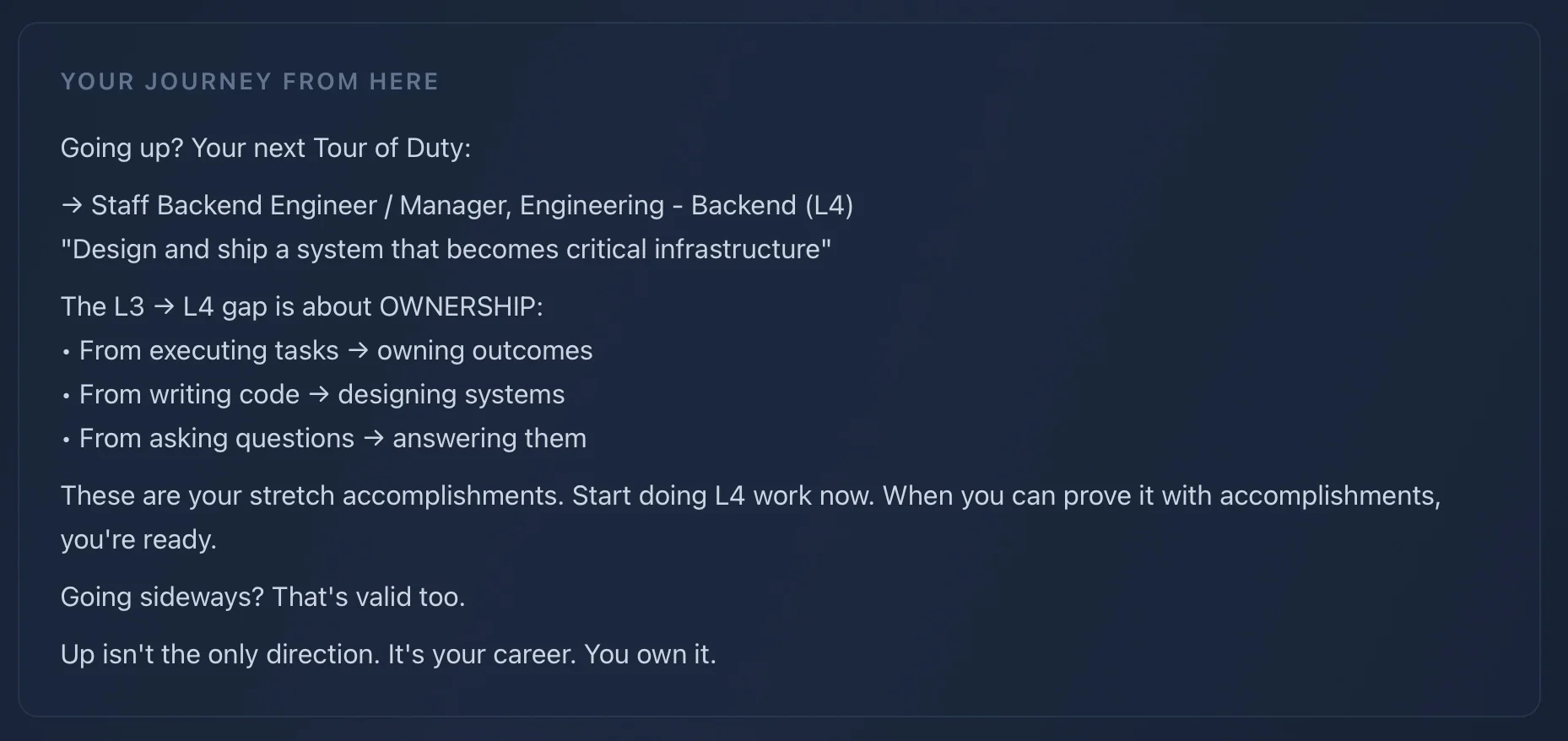
Each DRS also shows the gap between the current level and the next — the specific shifts in competency and scope that mark the transition. The L3 to L4 gap reads:
From executing tasks → owning outcomes. From writing code → designing systems. From asking questions → answering them.
And it includes stretch accomplishments — things you should start doing now to prove you’re ready. This is the bridge between tours, made explicit.
Competencies, not skills
One of the design decisions I find most compelling: TailorCV uses 26 competencies, not thousands of skills.
Skills have an 18-month half-life. “Terraform” is a skill. “IT Operations” is a competency. The skill changes with your employer, your stack, your decade. The competency deepens across every tour of duty in your career.
A tour develops competencies. The skills are just the tools you happened to use along the way. This distinction matters because competencies are what compound — they’re the persistent unit that travels with you when the tour ends.
The career paths are real
TailorCV has mapped 19 paths to the C-suite across five career groups, covering 167 career areas and 1,537 Digital Role Specifications at nine levels of seniority. This is competency-based career pathing at a scale that didn’t exist before — free, public, and detailed enough to actually plan against.
Want to know how to become a CTO? There are two distinct routes — through Software Engineering or through Quality Engineering. Each traces through different rotational tours with different competency requirements. The path to CTO isn’t a straight line; it’s a series of missions.
Want to know how to become a CMO? Marketing has more internal specializations than almost any other function. The rotational tours build fluency across demand gen, brand, content, and growth. Skip them, and you stall.
Want to know how to become a CHRO? This is one I find particularly relevant. The function that architects how organizations scale their most valuable asset — people — often lacks the most structured path for its own professionals. Six routes, nine seniority levels, each building a different kind of leader.
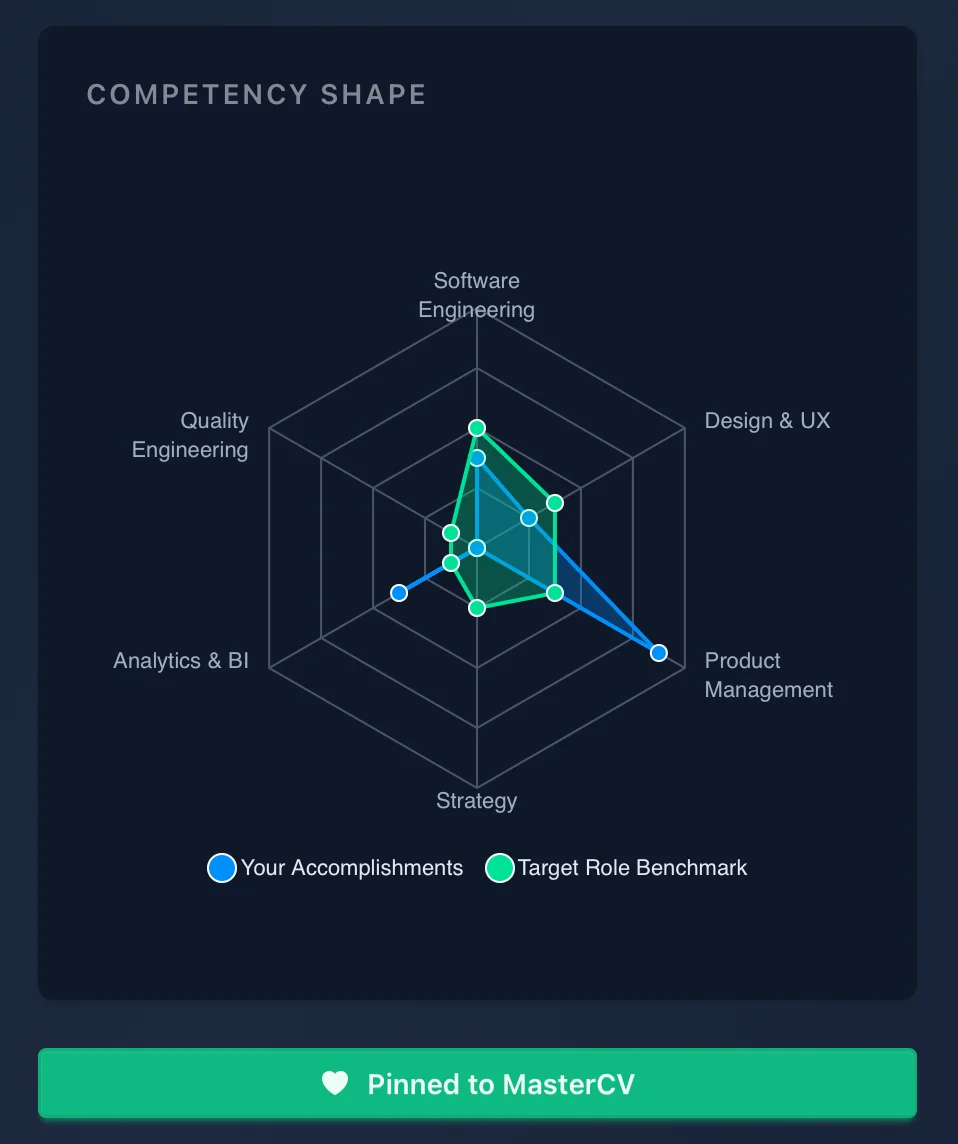
You can see where you stand on any of these paths right now — import your LinkedIn profile and get your career gap report in under two minutes. It’s free.
From personal tool to career intelligence
Here’s what makes this more than a personal productivity tool.
When you sign up for TailorCV, you can import your LinkedIn profile and convert your legacy resume into a living career record. Pin a role — say, VP of Engineering — and get a detailed report on where you stand: where you’re ahead, where you have gaps, and what your next tour of duty should focus on.
That’s useful on its own. But when thousands of professionals do this, something else emerges: a transparent model of how careers actually work. Not job postings. Not LinkedIn profiles optimized for appearances. The real details of specific career paths.
LinkedIn verifies who you are and where you work. TailorCV adds a third dimension: verification of what you’ve actually done, from the people who were there. As AI is increasingly used to generate resumes — and, intentionally or not, to hallucinate accomplishments — a verified work signal matters more than ever. Resume fraud isn’t new, but AI has industrialized it. The antidote isn’t more screening; it’s a career record where accomplishments are verified at the source.
Think about how the simple title of “Product Manager” conceals how different the job is at Amazon versus Nvidia. Over time, TailorCV can surface those differences — because the data comes from structured, verified career records, not self-reported profiles.
What this means
For individuals, your career becomes a sequence of documented, verified tours. When a tour ends, your verified accomplishments are structured and portable. They belong to you, not your employer’s HR system.
For organizations, Tour of Duty stops being a philosophy that depends on exceptional managers and becomes infrastructure backed by data. The conversation moves from “how should we think about careers?” to “here’s the career path, here’s where this person stands, here’s the mission.”
For many years, my advice to young people charting their career has been to study the LinkedIn profile of someone who has the career you want, and work backward. But that approach is manual and subjective. TailorCV can analyze orders of magnitude more data to give you a more detailed and realistic path. AI is putting pressure on every role, but people still need to learn — they can’t skip from entry-level to senior overnight. With AI, they can progress faster. TailorCV has exposed that path, quantitatively.
The Tour of Duty framework was always right. It just needed a system of record.
Wherever you are in your career, it’s time to stop guessing about your next steps. Import your LinkedIn profile, pin a role, and see exactly where you stand — it takes two minutes and it’s free.
Start your career record — free, forever.
Get Started